Hassan El Shark
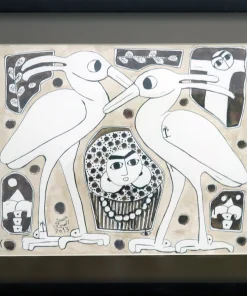
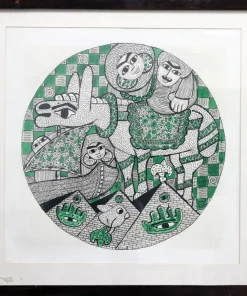
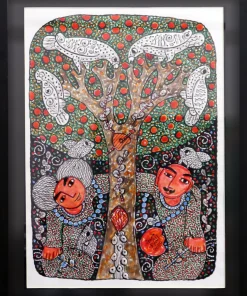
Born in 1949, in the village of Zawiyet Sultan in Minya Hassan was the son of a butcher and the eldest of six siblings . He spend his childhood in his village east of the Nile, nestled near a mountain surrounded by numerous shrines of revered saints.
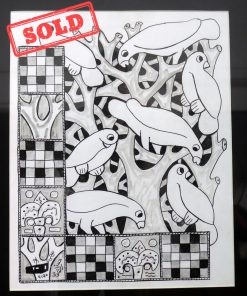
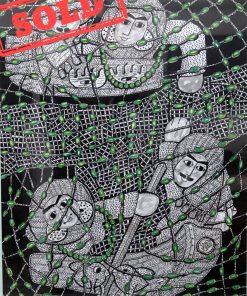
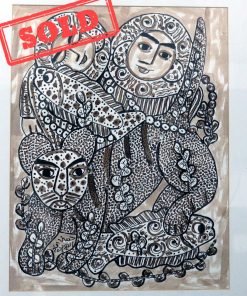
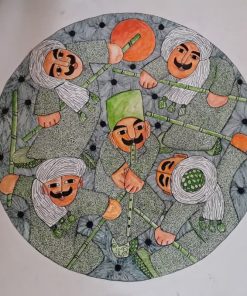
In an interview with our sister-platform BabMasr, El-Sharq recounted, “My science teacher in primary school encouraged me after seeing my drawings on the walls and desks. He pushed me to draw educational subjects, scientific devices and illustrations used to explain and clarify the subjects we were taking.” Growing up in a village that blended rural and urban elements, Hassan drew inspiration from his surroundings—depicting the Nile, greenery, and dome-shaped houses. He used chalk and pens to draw on walls and later began dedicating notebooks to his art.
He did not complete his formal education and started working in his father’s butcher shop. Despite being compelled to work there, his artistic soul could not continue down that path. His canvases were the meat wrapping paper from his father’s shop, his brushes were made from palm fronds, and his paints were sourced from the local spice shop—yellow from turmeric, brown from licorice, and blue from laundry dye. Thus began his journey with his talent, which remained hidden within his village for 25 years.
His international recognition began when German orientalist Ursula Schwerin visited Minya Governorate in 1985. She saw his works and was deeply impressed. She organized an exhibition for him in Cairo, which was a great success. From there, his journey to international recognition began with a series of exhibitions. The first was in Stuttgart, Germany, followed by Munich. In 1991, an exhibition was held in France, including at the Louvre Museum, and later in Switzerland. In 1994, his work was displayed at the famous Burghausen Castle in Germany, after which he was awarded the key to the city of Neuulm in recognition of